AI Marketing Automation for Small Business: Your Complete Guide to Smarter Growth in 2026
Discover how AI marketing automation helps small businesses save time, increase conversions, and compete with larger companies—without enterprise budgets.
Your competitors just hired a marketing team that works 24/7, never takes vacations, and costs less than a part-time employee. They're using AI marketing automation, and if you're still manually sending emails at 11 PM or scrambling to respond to website inquiries the next morning, you're already behind.
The gap between businesses using AI automation and those relying on manual processes isn't just widening—it's becoming a chasm. Companies leveraging AI marketing automation see 451% increases in qualified leads, according to recent data from The Annuitas Group. Meanwhile, businesses stuck in manual mode are burning hours on repetitive tasks that machines handle better, faster, and cheaper.
Here's what you need to know about AI marketing automation and how to implement it without a Fortune 500 budget.
What Is AI Marketing Automation (And What It Isn't)
AI marketing automation for small business combines machine learning algorithms with marketing software to handle repetitive tasks, make data-driven decisions, and personalize customer experiences at scale. Think of it as your marketing department's operating system—running in the background, making thousands of micro-decisions that would overwhelm any human team.
But let's clear up a common misconception: AI marketing automation isn't about replacing human creativity or strategy. A tool can't write your brand story or understand what makes your Billings-based customers tick. What it does is handle the execution and optimization of your marketing strategy so you can focus on the creative and strategic work that actually moves your business forward.
The Real-World Difference
Without AI automation, sending a promotional email means manually segmenting your list, writing one generic message, scheduling it, and hoping for decent open rates. With AI marketing automation for small business, the system analyzes each subscriber's behavior, sends personalized messages at optimal times, adjusts subject lines based on what resonates with specific segments, and automatically follows up based on engagement.
That's not theory. That's what's happening right now in businesses that have made the switch.
Why Small Businesses Can't Afford to Ignore AI Automation
The "wait and see" approach to AI marketing automation worked in 2022. In 2026, it's a liability. Here's why:
The Time Equation Has Changed
Small business owners spend an average of 11 hours per week on marketing tasks that AI can automate. That's 572 hours annually—equivalent to hiring a part-time employee just to handle what software now does better. When you're competing against businesses that have reclaimed those hours for strategy and growth, the disadvantage compounds quickly.
Customer Expectations Have Evolved
Your customers expect instant responses, personalized recommendations, and relevant content. They don't care that you're a small business with limited resources. Affordable AI chatbots for small business websites can provide 24/7 customer service that would cost $50,000+ annually if you hired human staff.
The Cost Barrier Has Collapsed
Enterprise-level AI marketing automation that cost $10,000+ monthly five years ago now exists in accessible platforms starting at $50-$200 per month. The technology that was once exclusive to Fortune 500 companies is now more affordable than hiring a marketing intern.
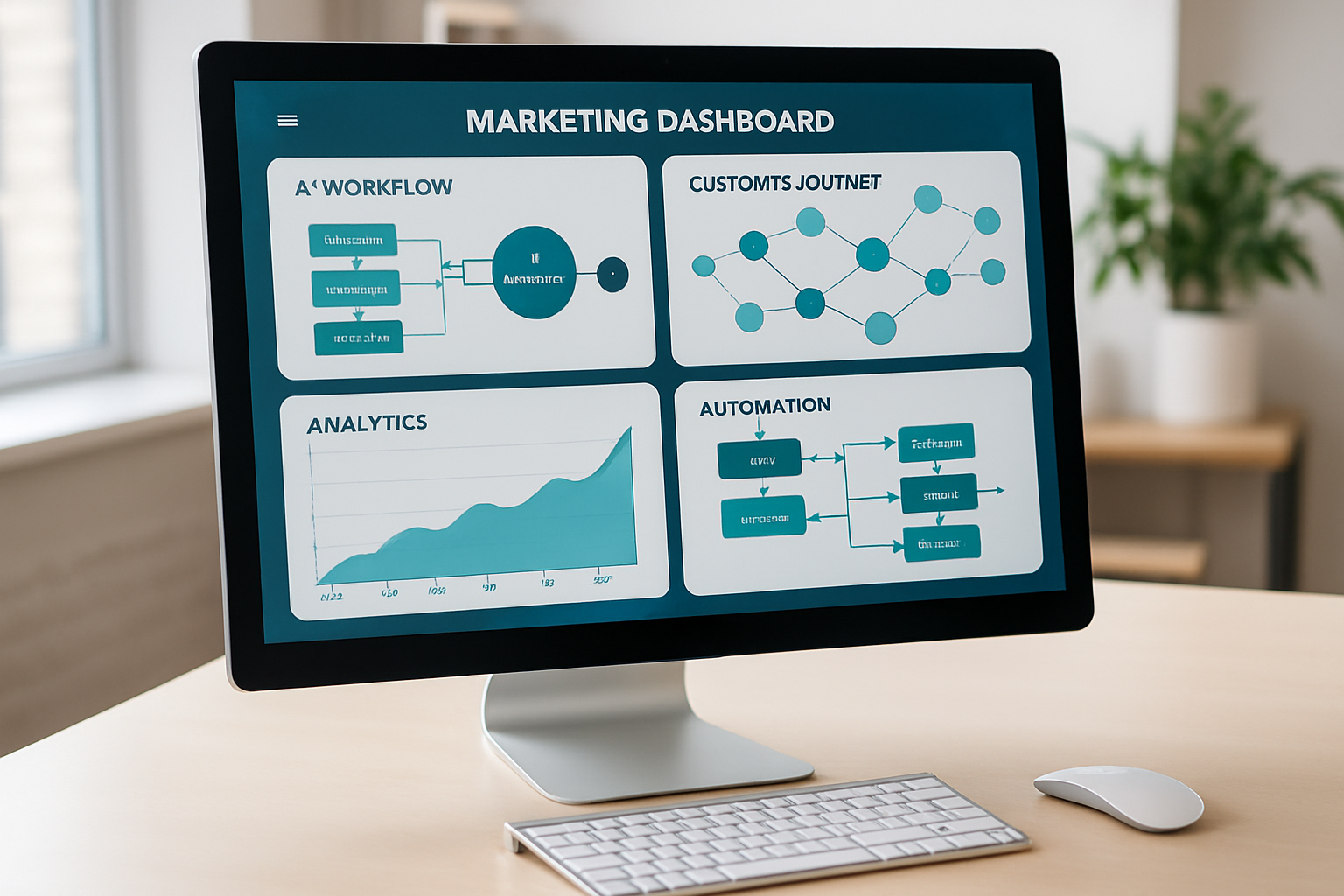
The Five Core Components of AI Marketing Automation
Effective AI marketing automation for small business rests on five pillars. You don't need all of them immediately, but understanding each component helps you build a system that actually generates results.
1. Intelligent Email Marketing
AI-powered email platforms go beyond basic automation. They analyze open rates, click patterns, and engagement timing to optimize every send. The system learns which subject lines work for different segments, what time your audience engages most, and which content drives conversions.
Our deep dive into best AI email marketing tools for SMBs covers specific platforms and features worth your investment, but the core principle remains: let AI handle the optimization while you focus on strategy and content quality.
2. Social Media Management and Scheduling
Posting consistently across multiple platforms while maintaining quality and relevance is unsustainable manually. AI social media tools analyze when your audience is most active, which content types generate engagement, and what posting frequency maximizes reach without causing fatigue.
These platforms don't just schedule posts—they recommend content, suggest optimal posting times based on real engagement data, and even generate variations of your content for different platforms. Check out our AI social media scheduling tools comparison to find the right fit for your business.
3. Lead Scoring and Qualification
Not all leads deserve equal attention. AI lead scoring systems analyze dozens of behavioral signals to identify which prospects are most likely to convert. They track website visits, content downloads, email engagement, and interaction patterns to assign scores that help you prioritize outreach.
For Montana businesses especially, where relationship-building matters deeply, knowing which leads to nurture versus which to pursue aggressively can make the difference between a strong quarter and a missed opportunity. Learn the specifics in our guide on how to automate lead scoring with AI.
4. Customer Segmentation
Generic marketing messages convert poorly because they speak to everyone and no one simultaneously. AI analyzes customer data to create precise segments based on behavior, preferences, purchase history, and engagement patterns.
This goes far beyond basic demographic segmentation. AI identifies patterns humans miss—like customers who browse late at night being more likely to purchase during evening email sends, or clients who engage with video content having higher lifetime values. Our article on AI customer segmentation for small businesses walks through practical implementation strategies.
5. Chatbots and Conversational AI
Website visitors who don't get immediate answers leave. AI chatbots provide instant responses, qualify leads, book appointments, and answer common questions without human intervention. The sophisticated ones learn from interactions and improve over time.
For small businesses competing against larger companies, chatbots level the playing field by providing enterprise-level responsiveness at a fraction of the cost.
Building Your AI Marketing Stack: A Practical Approach
The biggest mistake small businesses make with AI marketing automation is trying to implement everything simultaneously. You end up overwhelmed, underleveraged, and convinced the technology doesn't work.
Start with your biggest pain point. If you're drowning in email management, begin there. If social media consistency is killing you, start with scheduling automation. If you're losing leads because you can't respond fast enough, implement a chatbot first.
The Crawl-Walk-Run Framework
Crawl Phase (Months 1-2): Implement one AI tool that addresses your most time-consuming marketing task. Master it completely before adding complexity. Set up basic automations, learn the interface, and establish benchmarks for success.
Walk Phase (Months 3-5): Add a second component that complements your first tool. If you started with email automation, add lead scoring. If you began with chatbots, layer in customer segmentation. Focus on integration and data flow between systems.
Run Phase (Month 6+): Build a fully integrated AI marketing stack where data flows seamlessly between tools. Your chatbot feeds qualified leads to your CRM, which triggers personalized email sequences, while your social media AI posts content optimized for segments identified by your customer analysis.
Integration Matters More Than Features
Five mediocre tools that work together beat three excellent tools that operate in silos. When evaluating AI marketing automation for small business, prioritize platforms that integrate with your existing systems. Your AI email tool should connect to your CRM. Your chatbot should feed your lead scoring system. Your social media scheduler should pull data from your analytics.
Common Mistakes That Waste Money and Time
After helping dozens of Montana small businesses implement AI marketing automation, we've seen the same expensive mistakes repeated. Here's what to avoid:
Buying Based on Features, Not Needs
That platform with 47 AI features sounds impressive until you realize you'll only use four of them. Complexity without purpose creates confusion, not results. Buy the simplest tool that solves your specific problem, then expand as needed.
Skipping the Data Cleanup
AI marketing automation runs on data. Feed it garbage, get garbage results. Before implementing any AI tool, clean your contact lists, standardize your data fields, and establish consistent tracking. A week spent on data hygiene saves months of poor automation performance.
Setting and Forgetting
AI learns and optimizes, but it's not sentient. You still need to review performance, adjust strategies, and feed the system new information. Check your automations monthly. Review the data. Make adjustments. The businesses seeing 400%+ ROI improvements aren't just turning on automation—they're actively managing it.
Ignoring the Human Element
AI should enhance human connection, not replace it. Your automated emails should sound like they came from a person. Your chatbot should know when to hand off to a human. Your social media automation should leave room for spontaneous, authentic engagement.
Your 90-Day Implementation Roadmap
Here's a practical timeline for implementing AI marketing automation for small business without disrupting your current operations:
Days 1-30: Foundation
- Audit current marketing processes and identify time-consuming tasks
- Clean and organize customer data
- Choose one AI tool addressing your biggest pain point
- Set up basic tracking and establish current performance baselines
- Create simple automations (welcome emails, basic chatbot responses, scheduled social posts)
Days 31-60: Optimization
- Review first month's performance data
- Refine automations based on actual results
- Add second tool or expand functionality of first tool
- Train team on using and monitoring AI systems
- Begin A/B testing AI-generated variations
Days 61-90: Expansion
- Integrate multiple AI tools for seamless data flow
- Implement advanced segmentation strategies
- Scale successful automations
- Calculate actual ROI and adjust budget accordingly
- Plan next quarter's AI marketing initiatives
Measuring ROI: What Actually Matters
Vanity metrics kill marketing budgets. Your AI marketing automation should move numbers that matter to your bottom line:
Time Savings
Track hours saved weekly on automated tasks. Multiply by your hourly rate or employee costs. This is your baseline ROI before any performance improvements.
Conversion Rate Improvements
Compare conversion rates before and after AI implementation. A 2% improvement in email conversion or a 15% increase in qualified leads directly translates to revenue.
Customer Lifetime Value
AI-powered personalization typically increases customer lifetime value by 10-30%. Track this metric quarterly to understand long-term impact.
Response Time and Engagement
Measure how quickly you respond to leads and how engagement rates change with AI automation. Faster response times correlate directly with higher close rates.
For Billings businesses specifically, where word-of-mouth and relationship-building drive growth, improved responsiveness and personalization create compounding benefits that pure analytics might undervalue.
The Next Step in Your Marketing Evolution
AI marketing automation for small business isn't optional anymore—it's table stakes for competitive operation in 2026. The businesses thriving right now aren't necessarily the ones with the biggest budgets or the most staff. They're the ones leveraging technology to work smarter, respond faster, and personalize at scale.
You don't need to become an AI expert or overhaul your entire marketing operation overnight. Start with one tool that solves one problem. Master it. Expand from there. The gap between where you are and where you could be isn't about technology—it's about taking the first step.
At Agency 220, we help Montana small businesses implement AI marketing automation that actually generates ROI. We handle the technical complexity so you can focus on running your business. If you're ready to stop spending nights and weekends on marketing tasks that machines handle better, let's talk about building your AI marketing stack.
Frequently Asked Questions
How much does AI marketing automation cost for a small business?
AI marketing automation for small businesses typically costs between $50-$500 monthly depending on features and scale. Entry-level platforms like Mailchimp's AI features start around $50/month, while more comprehensive solutions range from $200-$500. This is significantly less than hiring even part-time marketing help, and most businesses see positive ROI within 3-6 months through time savings and improved conversion rates.
Do I need technical skills to implement AI marketing automation?
No technical skills are required for most modern AI marketing automation platforms. Today's tools are designed for business owners, not developers, with drag-and-drop interfaces and pre-built templates. You can set up basic automations in hours, not weeks. However, partnering with a marketing agency can accelerate implementation and ensure you're leveraging advanced features that drive better results.
Will AI marketing automation make my business feel impersonal?
When implemented correctly, AI marketing automation actually increases personalization. The technology analyzes customer behavior to deliver more relevant, timely messages than manual methods allow. The key is maintaining authentic voice in your automated content and knowing when to transition from automation to human interaction. AI should enhance relationships, not replace them.
How long before I see results from AI marketing automation?
Time savings appear immediately—most businesses reclaim 5-10 hours weekly in the first month. Performance improvements like higher conversion rates typically emerge within 60-90 days as the AI learns from data and optimizes campaigns. Significant ROI improvements usually materialize in months 3-6 as you refine automations and expand implementation across more marketing channels.
What's the first AI marketing tool a small business should implement?
Start with whatever marketing task consumes most of your time. For most small businesses, that's email marketing, making AI-powered email platforms the best starting point. If customer service inquiries overwhelm you, begin with a chatbot. If social media consistency is your struggle, start with AI scheduling tools. The best first tool solves your biggest pain point—there's no universal answer.