How to Automate Lead Scoring with AI: A Practical Guide for Small Businesses
Learn how small businesses can use AI to automatically score leads, prioritize sales efforts, and boost conversion rates without enterprise budgets.
You're leaving money on the table. Every day, potential customers visit your website, open your emails, and interact with your business—but without a system to identify who's ready to buy, your sales team wastes time chasing cold leads while hot prospects slip away. For small businesses in competitive markets like Billings, that's not just inefficient—it's expensive.
Lead scoring used to require dedicated marketing teams and expensive enterprise software. Not anymore. AI-powered automation now makes sophisticated lead scoring accessible to businesses of any size, and you can have it running in days, not months.
What Is AI Lead Scoring and Why Does It Matter?
Lead scoring assigns numerical values to prospects based on their behavior and characteristics. Traditional lead scoring relied on manual rules—if someone downloads a whitepaper, add 10 points; if they visit the pricing page, add 20 points. The problem? Those rules are guesses, and they stay static even when your business changes.
AI lead scoring learns from your actual sales data. It identifies patterns in how your best customers behaved before they bought, then automatically scores new leads based on those patterns. The system gets smarter over time, adjusting scores as it learns what actually predicts a sale for your specific business.
This matters because your sales team only has so many hours in a day. When they know which leads are genuinely interested and ready to buy, they close more deals with less effort. It's that simple.
How AI Lead Scoring Actually Works
Here's what happens behind the scenes when you automate lead scoring with AI:
Data Collection: The system tracks everything—email opens, website visits, form submissions, social media interactions, and any other touchpoint you connect to it. This is where integration with best AI email marketing tools for SMBs becomes crucial, since email behavior is often your strongest signal.
Pattern Recognition: AI algorithms analyze your historical data to find correlations. Maybe customers who visit your pricing page three times and open at least two emails convert at 60%, while those who only visit your blog convert at 5%. The AI spots these patterns automatically.
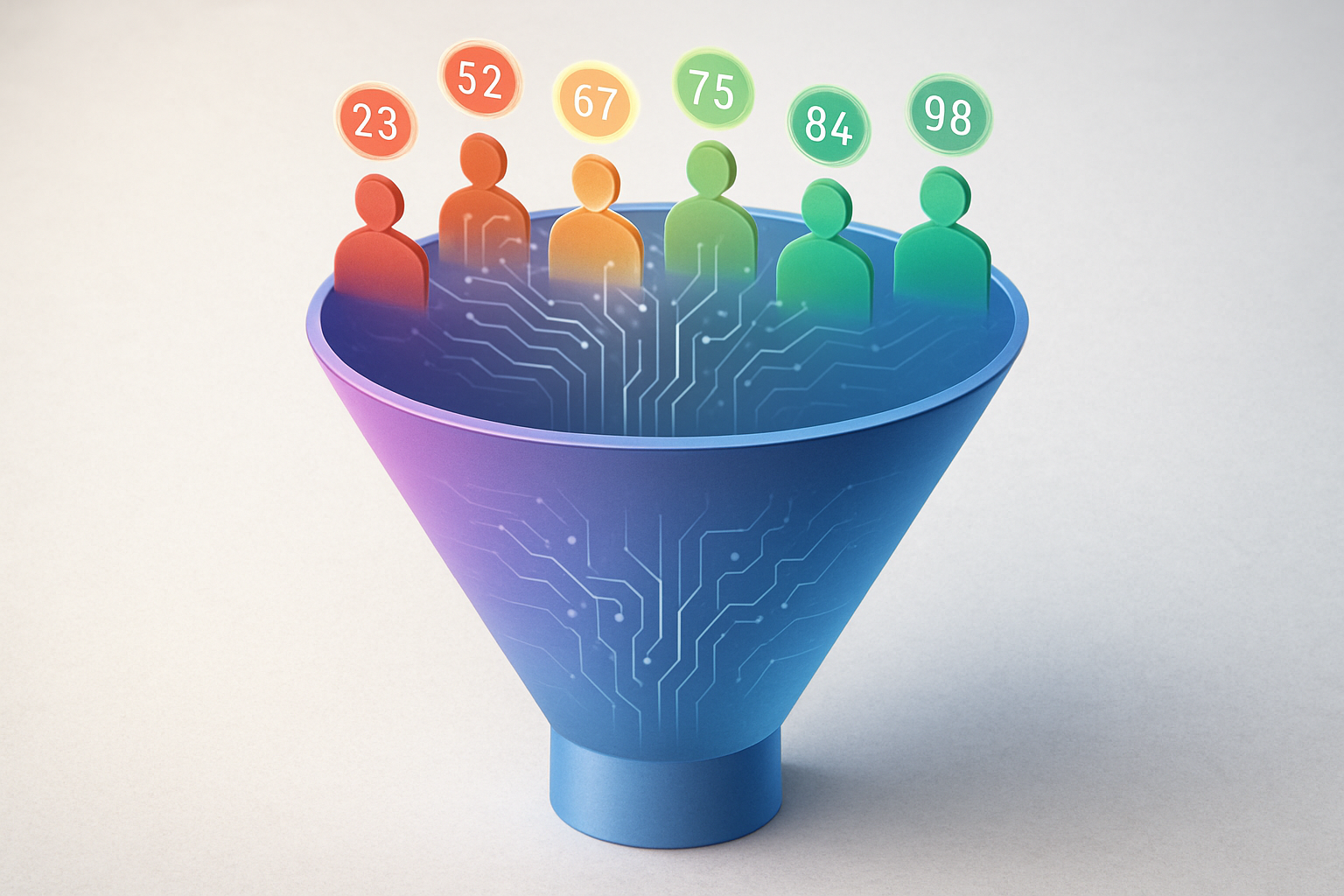
Predictive Scoring: Based on those patterns, the system assigns each lead a score—typically 0-100. Higher scores mean higher likelihood of conversion. The AI continuously updates these scores as leads take new actions.
Automatic Segmentation: Once leads are scored, they're automatically sorted into categories. Hot leads go straight to sales. Warm leads enter nurture campaigns. Cold leads get educational content. This connects directly to AI customer segmentation for small businesses, creating a seamless workflow from scoring to action.
Setting Up Your AI Lead Scoring System
You don't need a computer science degree to implement this. Here's the step-by-step process:
Step 1: Choose Your Platform
Most modern CRM systems now include AI lead scoring—HubSpot, Salesforce, and ActiveCampaign all offer it. If you're already using one of these platforms, you may already have access. Smaller businesses might start with dedicated tools like Leadfeeder or Madkudu, which integrate with existing systems.
The key is picking a platform that connects with your current tools. If your email marketing, website, and CRM don't talk to each other, the AI can't learn from complete data.
Step 2: Define Your Conversion Goal
What counts as a conversion for your business? A demo request? A purchase? A consultation booking? Be specific. The AI needs a clear target to learn from. If you have multiple conversion types (say, small product purchases and large consulting contracts), you may want separate scoring models for each.
Step 3: Connect Your Data Sources
Integrate everything that touches your leads—your website, email platform, social media, and any forms or chatbots you use. Speaking of which, affordable AI chatbots for small business websites can be excellent data sources, capturing real-time intent signals as visitors ask questions.
Most platforms make this easy with pre-built integrations. You're typically looking at a few hours of setup time, not days.
Step 4: Let the AI Learn
This is the hardest part: waiting. The AI needs historical data to identify patterns. If you have at least 100-200 past conversions in your system, most AI models can start making useful predictions immediately. If you're starting fresh, expect to wait 2-3 months while the system collects data.
During this learning period, you can still use basic rule-based scoring as a placeholder.
Step 5: Set Score Thresholds and Actions
Decide what happens at different score levels. Here's a common setup:
- 80-100 (Hot): Immediate sales notification, personal outreach within 24 hours
- 60-79 (Warm): Automated email sequence with product information and case studies
- 40-59 (Cool): Educational content nurture campaign
- 0-39 (Cold): Minimal engagement, occasional newsletter
These thresholds aren't set in stone. Test and adjust based on your team's capacity and close rates at each level.
Making AI Lead Scoring Work for Your Business
Implementation is one thing. Getting results is another. Here's how small businesses actually succeed with this:
Start with one channel. Don't try to score leads from every possible source on day one. Begin with your strongest channel—probably email or website—and expand from there.
Train your sales team. If your team doesn't trust the scores, they won't use them. Show them the data. Prove that high-scored leads convert at higher rates. Get their feedback and adjust thresholds together.
Combine AI scoring with human judgment. The AI might miss context—maybe a lead works at your dream client company but has a low score because they're early in research. Give your team permission to override scores when it makes sense.
Keep your data clean. AI is only as good as the data it learns from. If your CRM is full of duplicate contacts, outdated information, or test entries, your scores will be garbage. Schedule quarterly data cleanups.
Integrate with your broader automation strategy. Lead scoring is most powerful when it's part of a complete system. The comprehensive approach outlined in AI marketing automation for small business shows how scoring fits into a bigger picture that includes email, social media, and customer communications.
Common Mistakes to Avoid
Most small businesses make the same errors when automating lead scoring. Here's what to watch for:
Scoring too many attributes. More data isn't always better. If you're tracking 50 different behaviors, you're probably diluting the signal. Focus on the 5-10 actions that actually correlate with sales.
Ignoring negative scoring. Some behaviors should lower a score. If someone unsubscribes from emails, that's a clear signal they're not interested. Adjust scores down for these actions.
Setting it and forgetting it. Your business changes. Your customers change. Review your scoring model quarterly. Are the patterns still accurate? Are the thresholds still right?
Not accounting for time decay. A lead who visited your pricing page yesterday is hotter than one who visited six months ago. Good AI scoring models include time-based decay, lowering scores as actions get older.
The ROI Reality for Small Businesses
Let's talk numbers. A typical small business sees these improvements within 3-6 months of implementing AI lead scoring:
- 20-30% increase in conversion rates (because sales focuses on better leads)
- 30-50% reduction in time spent on unqualified leads
- 15-25% shorter sales cycles (hot leads move faster)
For a Billings-based business doing $500K in annual revenue with a 10% close rate, even a conservative 20% improvement in conversions means an extra $100K in sales—without spending more on lead generation.
The cost? Most small businesses spend $100-500 per month on AI-enabled platforms, depending on contact volume. If you're already paying for a CRM, the additional cost for AI features is often minimal or even included.
Moving Forward with AI Lead Scoring
You don't need to transform your entire marketing operation overnight. Start small. Pick one platform. Connect your primary data sources. Let the AI learn for a month or two. Then gradually expand as you see results.
The businesses winning in 2026 aren't necessarily the ones with the biggest budgets—they're the ones using their budgets most efficiently. When you know exactly which leads deserve attention, your team works smarter. Your marketing dollars stretch further. Your close rates climb.
And unlike manual lead scoring, which requires constant maintenance and guesswork, AI lead scoring improves on its own. The system you set up today will be smarter six months from now, automatically adapting to changes in your market and customer behavior.
Ready to stop guessing which leads matter and start knowing? At Agency 220, we help Billings businesses implement AI marketing systems that actually work—including lead scoring, automated email sequences, and complete integration across your marketing stack. Schedule a consultation and we'll show you exactly how AI lead scoring would work for your specific business.