Direct Mail Marketing for Small Business: The Complete Guide to Getting Real Results in 2026
Direct mail delivers 5-9% response rates when digital gets ignored. Here's how Montana small businesses build campaigns that actually acquire customers.
Your competitors are flooding inboxes with emails that get deleted in seconds. Meanwhile, direct mail sits on kitchen counters, office desks, and refrigerator doors for days—sometimes weeks. For Montana small businesses fighting for attention in crowded markets, that physical presence translates to customers who actually remember your name when they're ready to buy.
Here's what most business owners miss: direct mail isn't expensive when you measure cost per actual customer acquired. It's expensive when you treat it like a digital channel and spray generic postcards at everyone with a mailbox. The difference between those two approaches determines whether you're building a predictable customer acquisition system or burning money on pretty paper.
Table of Contents
Why Direct Mail Still Works in a Digital World
Physical mail triggers different cognitive pathways than digital content. Your brain processes tangible objects with more attention and memory encoding than pixels on a screen. That's not marketing theory—it's neuroscience.
For small businesses in Billings and across Montana, this matters because your customers receive 100+ marketing emails daily but only 2-3 pieces of personal mail. You're not fighting for attention in an inbox algorithm. You're sitting alone on a kitchen table.
The response rates tell the story. While email marketing hovers around 1-2% open rates for cold prospects, direct mail consistently pulls 5-9% response rates when properly targeted. The math gets even better when you factor in customer lifetime value. A roofing company spending $2 per mailer to acquire a $15,000 customer isn't expensive—it's the smartest money they'll spend all year.
Understanding direct mail vs email marketing ROI helps you allocate your marketing budget strategically rather than emotionally.
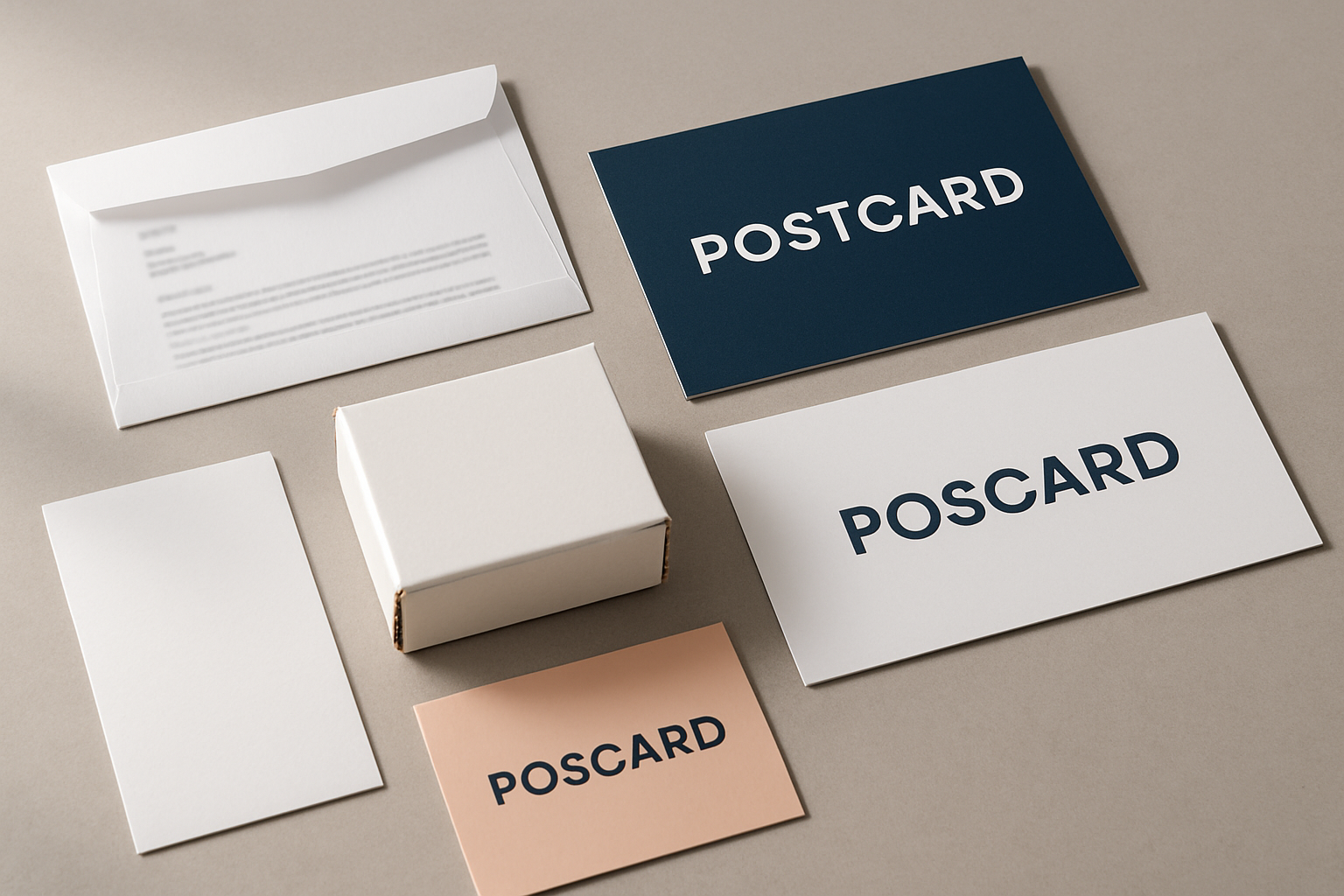
Types of Direct Mail That Actually Generate Response
Not all direct mail pieces perform equally. Your format choice should match your objective, not your aesthetic preferences.
Postcards
The workhorse of direct mail marketing. Postcards deliver immediate visibility—no envelope to open means your message gets seen. They're cost-effective for testing new markets, announcing limited-time offers, or maintaining top-of-mind awareness with past customers.
Use postcards when your message is simple and your offer is compelling enough to stand alone. A restaurant announcing a new menu, a retail store promoting a weekend sale, or a service business offering a seasonal discount all work well in postcard format.
Letters
Letters convey importance and personalization that postcards can't match. The envelope itself creates curiosity—people open mail addressed specifically to them.
Deploy letters when you're selling higher-ticket services, need to explain complex benefits, or want to establish authority. A financial advisor explaining retirement planning strategies, a B2B consultant proposing custom solutions, or a premium service provider making an exclusive offer all benefit from letter format.
Dimensional Mail
Boxes, tubes, and oversized packages command attention through sheer physical presence. They almost always get opened, making them powerful for high-value prospects or reactivating dormant customers.
The cost per piece runs higher, but the response rates justify it when you're targeting qualified prospects worth significant lifetime value. A real estate agent sending a market report in a branded tube, a business coach sending a printed guide with a handwritten note, or a luxury service provider sending a dimensional package all create memorable impressions that generic mail can't touch.
Self-Mailers
Brochures, flyers, and catalogs that don't require envelopes fall into this category. They work well for complex product lines, service menus, or educational content that requires multiple pages.
Restaurants, home service companies with multiple offerings, and retail businesses with seasonal catalogs all use self-mailers effectively. The key is making the front panel compelling enough to earn the open.
Building Your Direct Mail Strategy From Scratch
Strategy determines whether your direct mail builds a business or just depletes your budget. Start with these foundational decisions.
Define Your Ideal Recipient
Mass mailing is mass waste. The businesses winning with direct mail know exactly who they're targeting and why those specific people need their specific solution right now.
Get granular. Instead of "homeowners," target "homeowners in zip codes 59101-59106 who purchased homes 8-12 years ago" if you're selling roof replacements. Instead of "small businesses," target "professional service firms with 5-20 employees established 3-7 years ago" if you're selling business coaching.
The more specific your targeting, the more relevant your message becomes. Relevance drives response. Generic messages generate garbage can visits.
Our guide on direct mail list segmentation strategies walks through the exact process of identifying and refining your target segments.
Craft an Offer They Can't Ignore
Your offer determines your response rate more than your design, your copy, or your format combined. A compelling offer in ugly typography outperforms beautiful design with a weak offer every single time.
Strong offers solve immediate problems, remove risk, or create urgency. "Free roof inspection with drone footage" beats "professional roofing services." "First month free, cancel anytime" beats "flexible membership options." "Save $500 if you book by March 31" beats "competitive pricing."
The best offers make saying yes easier than saying no.
Choose Your Campaign Type
One-time blasts work for announcements and events. Sequential campaigns work for building relationships and complex sales. The choice depends on your sales cycle and customer journey.
A retail store promoting a weekend sale runs a one-time campaign. A professional service firm building trust with high-value prospects runs a 3-5 piece sequence over 60-90 days, each piece building on the last.
Sequential campaigns consistently outperform one-and-done approaches for relationship-based businesses and considered purchases. The investment is higher, but so is the conversion rate.
Execution Essentials: From Design to Delivery
Strategy means nothing without flawless execution. These tactical elements determine whether your mail gets read or recycled.
Design That Drives Action
Direct mail design serves one purpose: moving the reader to your call-to-action. Every element either supports that goal or dilutes it.
Start with a clear visual hierarchy. Your headline should dominate the space, your offer should be immediately obvious, and your call-to-action should be unmissable. Cluttered layouts kill response rates faster than bad targeting.
Use images that show outcomes, not process. A homeowner relaxing on a beautiful new deck sells better than a contractor holding tools. A business owner confidently presenting to clients sells better than a coach talking at a whiteboard.
For detailed guidance on creating mail pieces that actually get read, check out our direct mail design tips for small business.
Copy That Converts
Write like you talk, not like you're trying to impress English professors. Conversational copy builds connection. Corporate jargon builds distance.
Lead with benefits, not features. "Cut your electric bill in half" beats "high-efficiency HVAC systems." "Get more customers without spending more on ads" beats "comprehensive digital marketing solutions."
Keep sentences short. Paragraphs shorter. White space abundant. Readers skim before they read. Make skimming rewarding.
Printing and Production
Print quality matters more for premium services than discount offers. A luxury real estate agent can't mail cheap, thin-stock postcards. A pizza shop can't justify premium linen cardstock.
Match your production values to your positioning and price point. The quality of your mail piece signals the quality of your service—whether you intend it to or not.
Work with local printers when possible for faster turnaround and easier troubleshooting. Montana has excellent commercial printers who understand regional considerations and can often beat national providers on price for smaller runs.
List Acquisition and Management
You can buy lists or build them. Purchased lists get you to market faster but come with accuracy issues and compliance requirements. Built lists take longer but convert better because they're precisely targeted.
For purchased lists, work with reputable data providers who offer NCOA (National Change of Address) updates and guarantee accuracy rates above 95%. Bad addresses aren't just wasted postage—they damage your sender reputation.
For built lists, gather data from website forms, point-of-sale systems, event registrations, and partnership opportunities. A single well-maintained house list of past customers and qualified prospects often outperforms larger rented lists.
Tracking and Optimization: Making Every Campaign Better
What you measure determines what you improve. Direct mail offers multiple tracking methods—use as many as your budget allows.
Response Tracking Mechanisms
Unique phone numbers, custom URLs, QR codes, and offer codes all tell you which pieces generated which responses. Without tracking, you're guessing. With tracking, you're optimizing.
Call tracking numbers cost $3-10 monthly and tell you exactly which mail pieces drove calls. Custom landing pages with UTM parameters show digital behavior triggered by physical mail. QR codes bridge offline to online seamlessly while capturing scan data.
The more granular your tracking, the smarter your future campaigns become. Test different offers, headlines, formats, and mailing schedules. Track everything. Scale what works. Kill what doesn't.
Learn how to properly measure campaign performance in our guide on measuring direct mail campaign success metrics.
Key Metrics to Monitor
Response rate tells you how many people took action. Conversion rate tells you how many became customers. Customer acquisition cost tells you if the economics work.
Track all three. A 10% response rate means nothing if only 5% convert. A 3% response rate with 50% conversion might be more profitable than higher response with lower conversion.
Calculate your breakeven response rate before you mail. If you need 2% conversion to profit, you know exactly what success looks like before you invest.
A/B Testing for Continuous Improvement
Test one variable at a time. Different offers, different headlines, different formats, different audiences. Send half your list version A, half version B. Measure. Learn. Apply to the next campaign.
Small improvements compound quickly. A campaign pulling 5% response becomes 7% with better targeting. Add a stronger offer and it jumps to 9%. Refine your design and you're at 11%. Each improvement builds on the last.
The businesses dominating with direct mail aren't lucky—they're systematic about testing and optimization.
Common Direct Mail Mistakes That Kill ROI
These errors appear in roughly 80% of failed campaigns. Avoid them and you're already ahead of most competitors.
Weak or Missing Calls-to-Action
Telling people what you do without telling them what to do next is marketing malpractice. Every piece needs a clear, specific, time-bound call-to-action.
"Call today" is weak. "Call 406-555-0123 by Friday for 20% off your first month" is strong. Specificity drives action. Vagueness drives procrastination.
Poor Targeting
Mailing to everyone in a zip code costs the same per piece as mailing to your perfect prospects. The response rates differ by 400-800%.
Invest time in targeting. The narrower your focus, the higher your conversion rate and the lower your customer acquisition cost.
Inconsistent Follow-Up
One mailer rarely closes a sale for considered purchases. Plan your sequence before you send piece one. A single mailer followed by silence is a waste of the awareness you just created.
Ignoring Budget Realities
Direct mail works at every budget level, but the approach changes dramatically between $500 and $50,000 campaigns.
If you're working with limited funds, our article on how to create a direct mail campaign on a budget shows you how to maximize results without maxing out your credit card.
Getting Started: Your First Campaign
Theory means nothing without action. Here's your roadmap from decision to delivery.
Step 1: Define Success
What specific outcome makes this campaign worth the investment? New customers? Reactivated past customers? Event registrations? Be specific. "More business" isn't a goal. "15 new customers at $85 acquisition cost" is a goal.
Step 2: Build or Buy Your List
Start small. A highly targeted list of 250 perfect prospects beats a scattered list of 2,500 random names. Test, learn, scale.
Step 3: Create Your Offer and Message
What problem do you solve? Why should they care? What should they do next? Answer those three questions clearly and you've got your core message.
Step 4: Design and Produce
Work with a designer who understands direct response, not just aesthetics. Pretty doesn't pay bills. Effective does.
Step 5: Mail and Track
Set up your tracking mechanisms before pieces hit mailboxes. Capture every response. Measure every metric.
Step 6: Follow Up
Have your sales process ready to convert responses into customers. The campaign doesn't end when the mail delivers—it starts.
Making Direct Mail Work for Your Montana Business
Direct mail marketing for small business isn't complicated, but it does require strategic thinking and disciplined execution. The physical nature of mail creates opportunities that digital channels simply can't replicate—you just have to build campaigns that capitalize on those advantages.
Start with tight targeting, compelling offers, and clear calls-to-action. Track everything obsessively. Optimize relentlessly. Scale what works.
The Montana businesses crushing it with direct mail right now aren't doing anything magical. They're being strategic about who they target, what they offer, and how they measure results. You can do the same.
Agency 220 helps Billings businesses build direct mail campaigns that generate predictable, measurable customer acquisition. If you're ready to move beyond digital noise and get in front of your best prospects in a way they can't ignore, let's talk about your first campaign.
Frequently Asked Questions
How much does direct mail marketing cost for a small business?
Direct mail costs typically range from $0.50 to $3.00 per piece for small businesses, depending on format, quantity, and targeting. A basic postcard campaign to 500 recipients might cost $500-800 total including design, printing, and postage. More sophisticated campaigns with dimensional mail or multi-piece sequences cost more but often generate proportionally higher returns. The key is matching your investment to your customer lifetime value—spending $2 to acquire a customer worth $500 makes financial sense.
What response rate should I expect from a direct mail campaign?
Well-targeted direct mail campaigns typically generate 5-9% response rates, significantly higher than email marketing's 1-2% for cold prospects. However, response rates vary based on your targeting quality, offer strength, and audience familiarity with your brand. House lists (past customers) often pull 10-15% or higher, while cold prospect lists typically generate 2-5%. The more targeted your list and compelling your offer, the higher your expected response.
Is direct mail still effective in 2026?
Direct mail remains highly effective in 2026, particularly because digital channels have become oversaturated. People receive 100+ marketing emails daily but only 2-3 pieces of personal mail, making physical mail stand out dramatically. Neuroscience research shows the brain processes physical mail with greater attention and memory encoding than digital content. For small businesses competing for attention, this physical advantage translates to higher response rates and better customer acquisition costs than most digital channels.
How do I track the results of my direct mail campaign?
Track direct mail results using unique phone numbers, custom landing page URLs, QR codes, or specific offer codes. Call tracking services cost $3-10 monthly and tell you exactly which mail pieces generated calls. Custom URLs with UTM parameters track website visits and conversions. QR codes provide scan data while bridging offline to online. Using multiple tracking methods gives you the most complete picture of campaign performance and helps you optimize future mailings.
Should I buy a mailing list or build my own?
Both approaches work depending on your timeline and resources. Purchased lists get you to market faster and provide access to highly specific demographic and behavioral data, but they cost $0.05-0.25 per name and have accuracy limitations. Built lists take longer to compile but convert better because they're precisely matched to your ideal customer and often include people already familiar with your brand. Most successful direct mail programs use both—purchased lists for expansion and house lists for highest-converting campaigns.