Direct Mail vs Email Marketing ROI: Which Channel Actually Makes You Money?
Direct mail averages 90% open rates vs email's 21%. But which channel delivers better ROI for your Montana business? Let's look at the real numbers.
You've got a limited marketing budget and every dollar needs to count. The question keeping you up at night: should you invest in direct mail or double down on email marketing?
Here's what most marketing advice won't tell you—both channels can deliver exceptional ROI, but they work completely differently. And choosing the wrong one for your business goal can burn through cash faster than a Billings summer heats up.
Let's cut through the noise and look at actual numbers, real-world performance data, and what works for Montana businesses competing for local attention.
The ROI Numbers: What the Data Actually Shows
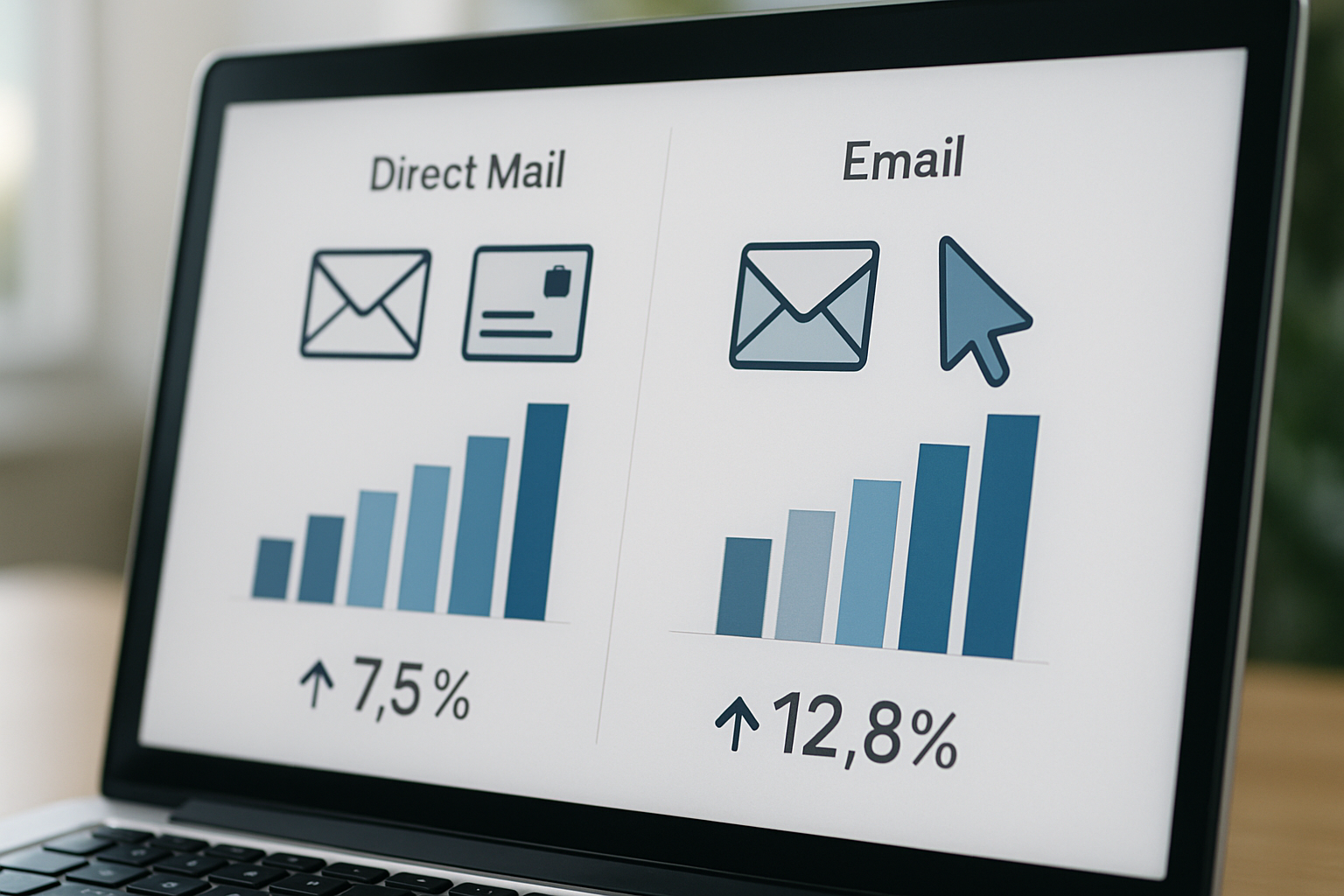
Email marketing typically delivers an average ROI of $36-$42 for every dollar spent, according to recent industry research. That's impressive on paper. Direct mail, meanwhile, averages around $7-$15 per dollar invested.
Case closed, right? Email wins?
Not so fast.
Those email numbers assume you have a quality list, good deliverability rates, and recipients who actually open your messages. The average email open rate across industries hovers around 21-22%. Your message needs to survive spam filters, crowded inboxes, and the delete button.
Direct mail has a 90% open rate. Yes, you read that right. Nine out of ten pieces get opened and looked at. When you're calculating actual eyeballs on your offer—not just theoretical reach—the math shifts dramatically.
Cost Per Acquisition: The Metric That Actually Matters
ROI percentages only tell half the story. What you really need to know is your cost per acquisition—how much you're spending to land one paying customer.
Let's run a real scenario for a Billings-based HVAC company:
Email campaign: You send 5,000 emails at $0.10 each ($500 total). With a 20% open rate, 1,000 people see your message. At a 2% conversion rate, you get 20 new customers. Cost per acquisition: $25.
Direct mail campaign: You send 1,000 postcards at $1.50 each ($1,500 total). With a 90% open rate, 900 people see your offer. At a 4% conversion rate (direct mail typically converts higher), you get 36 new customers. Cost per acquisition: $41.67.
Email looks cheaper per customer. But here's where it gets interesting—the direct mail customers typically have 40-60% higher lifetime value. They're more committed, respond better to follow-up offers, and refer others more frequently.
Understanding measuring direct mail campaign success metrics helps you track these longer-term value indicators that email-only campaigns often miss.
Response Rates: Why Physical Mail Still Wins Attention
The average person receives 121 emails per day. They might get 2-3 pieces of direct mail.
Which one has a better chance of being remembered?
Direct mail response rates average 5-9% for house lists (existing customers) and 1-3% for prospect lists. Email response rates struggle to hit 1% in most industries. When you factor in that your email might not even make it to the inbox, direct mail's advantage becomes clear.
Here's what we see working for Montana businesses: combining both channels in sequence. Send a direct mail marketing for small business piece first to break through the noise, then follow up with email to nurture the relationship. This one-two approach can boost overall campaign ROI by 20-35%.
When Email Marketing Wins
Email makes perfect sense for certain business scenarios, and ignoring it would be foolish.
You should prioritize email when:
- You're nurturing existing customer relationships and need frequent touchpoints
- Your product requires education and multiple interactions before purchase
- You're targeting a younger demographic (under 35) who prefer digital communication
- You need to send time-sensitive offers or updates
- Your budget is extremely limited and you need maximum reach
Email excels at maintaining ongoing conversations. It's your relationship tool, not your breakthrough tool.
When Direct Mail Delivers Better ROI
Direct mail outperforms email in specific situations that align with how most Montana small businesses actually operate.
Choose direct mail when:
- You're targeting an older demographic (45+) who respond better to physical marketing
- Your offer is high-value (over $500) and needs to stand out
- You're entering a new market and need to build brand awareness
- Your competitors rely heavily on digital and you can own the physical mailbox
- You want to create a tangible brand experience people can touch and keep
Local service businesses—HVAC, roofing, landscaping, dental practices—consistently see better ROI from direct mail for new customer acquisition. The physical presence builds trust that an email simply can't match.
Smart direct mail list segmentation strategies let you target the exact neighborhoods and demographics most likely to convert, making every dollar work harder.
The Real Secret: Integration and Testing
The businesses seeing the highest marketing ROI in 2026 aren't choosing between direct mail and email. They're using both strategically, playing to each channel's strengths.
Here's a proven sequence that works:
- Send a well-designed direct mail piece to your target list
- Follow up 3-5 days later with an email referencing the mailer
- Make a phone call or send a second email after another week
- Send a final direct mail postcard to non-responders after 30 days
This multi-touch approach can increase response rates by 30-50% compared to single-channel campaigns. The direct mail opens the door. Email keeps the conversation going. Together, they maximize your chances of conversion.
And yes, this works even when how to create a direct mail campaign on a budget is your reality. You don't need huge volumes—you need the right message reaching the right people at the right time.
Design Impact on ROI
Here's something most ROI comparisons ignore: design quality matters exponentially more for direct mail than email.
A poorly designed email might get a 0.5% response rate instead of 1%. A poorly designed direct mail piece might get zero response instead of 3%. The stakes are higher because you're investing more per piece.
Professional direct mail design tips for small business can double or triple your response rates, fundamentally changing the ROI equation. Color, layout, paper quality, and personalization all impact whether your piece gets read or recycled.
Email design matters too, but recipients are more forgiving of simple templates. With direct mail, you're competing against bills and catalogs from national brands—you need to look professional.
What Works for Montana Businesses Specifically
Montana presents unique marketing challenges. We're geographically spread out, with distinct urban and rural markets. What works in Billings might not resonate in smaller communities.
Direct mail performs exceptionally well throughout Montana for a few reasons:
- Lower mailbox competition than major metropolitan areas
- Strong preference for doing business with local companies
- Higher homeownership rates mean more stable mailing addresses
- Demographic skews slightly older, favoring physical marketing
Email remains essential for staying top-of-mind, but for initial customer acquisition, Montana businesses consistently report better results from direct mail—especially when targeting homeowners for services, retail for seasonal promotions, and B2B for high-value offers.
Making Your Decision
Stop thinking about direct mail vs email marketing ROI as an either-or choice. The question isn't which channel is better—it's which channel is better for your specific goal right now.
Need to acquire new customers quickly? Direct mail cuts through the noise. Want to nurture existing relationships? Email keeps you connected affordably. Launching something big? Use both in sequence for maximum impact.
Track everything. Test constantly. Adjust based on actual results, not assumptions.
The marketing landscape keeps evolving, but one thing stays constant: businesses that understand their customer acquisition costs and optimize accordingly will always outperform those chasing vanity metrics.
Ready to develop a marketing strategy that actually moves the revenue needle? Agency 220 helps Montana businesses build integrated campaigns that combine the best of direct mail, email, and digital marketing. Let's talk about what will work for your specific business goals.