Online Reputation Management for Small Business: Your Complete 2026 Guide to Protecting and Building Your Brand
Learn how to monitor, protect, and build your online reputation to attract more customers and outrank competitors in 2026.
A single negative review cost Montana restaurant owner Sarah Chen 23% of her monthly reservations in two weeks. She didn't respond to it, didn't address the customer's concern, and assumed it would blow over. It didn't. By the time she reached out to our team at Agency 220, her star rating had dropped from 4.8 to 3.6, and competitors were outranking her on every local search term that mattered.
That's the cold reality of running a small business in 2026: your reputation isn't just word-of-mouth anymore. It's Google reviews, social media comments, forum discussions, and customer testimonials that appear before you even get a chance to make a first impression. Ignore it, and you're not just losing customers—you're handing them directly to your competition.
Here's what you need to know about protecting and building your online reputation.
What Is Online Reputation Management (And Why It Matters More Than Ever)
Online reputation management for small business is the practice of monitoring, influencing, and improving how your company appears across digital channels. It's not just about damage control when something goes wrong—though that's part of it. It's about actively shaping the narrative around your brand before problems emerge.
Think of it as the digital equivalent of keeping your storefront clean and your customer service sharp. Except instead of one physical location, you're maintaining your presence across Google, Facebook, Yelp, industry forums, and dozens of other platforms where customers form opinions about your business.
The shift happened gradually, then all at once. Ten years ago, a customer might tell ten friends about a bad experience. Today, they tell ten thousand with a single review. And according to BrightLocal's 2025 consumer research, 98% of consumers read online reviews for local businesses—up from 87% just three years ago.
For small businesses in Billings and across Montana, this matters even more. When you're competing in a smaller market, every review carries more weight. A handful of negative experiences can define your business in ways that would get lost in the noise in a larger city.
The Real Impact of Your Online Reputation on Revenue
Let's cut straight to what matters: money. Your online reputation directly affects your bottom line in three measurable ways.
Search Rankings and Visibility
Google's algorithm weighs your review quantity, quality, and recency when determining local search rankings. A business with 50 recent reviews and a 4.5-star average will consistently outrank a competitor with 10 old reviews at 5 stars. This isn't speculation—it's how Google Business Profile optimization works in 2026.
When someone in Billings searches for "best plumber near me" or "reliable HVAC company," your review profile determines whether you show up in the critical top three map pack results. Miss that placement, and you're invisible to most searchers.
Conversion Rates
Even when prospects find you, your reputation determines whether they contact you. Harvard Business School research found that a one-star increase in Yelp rating leads to a 5-9% increase in revenue. For a small business doing $500,000 annually, that's $25,000-$45,000 just from improving your star rating.
The effect compounds on your website. When you feature customer testimonials and positive reviews prominently—something we emphasize in our website design approach—conversion rates typically increase 15-30%.
Customer Lifetime Value
Here's what most businesses miss: reputation management doesn't just attract new customers. It keeps existing ones coming back. When customers see you actively responding to feedback, addressing concerns, and improving based on input, they develop loyalty that transcends price competition.
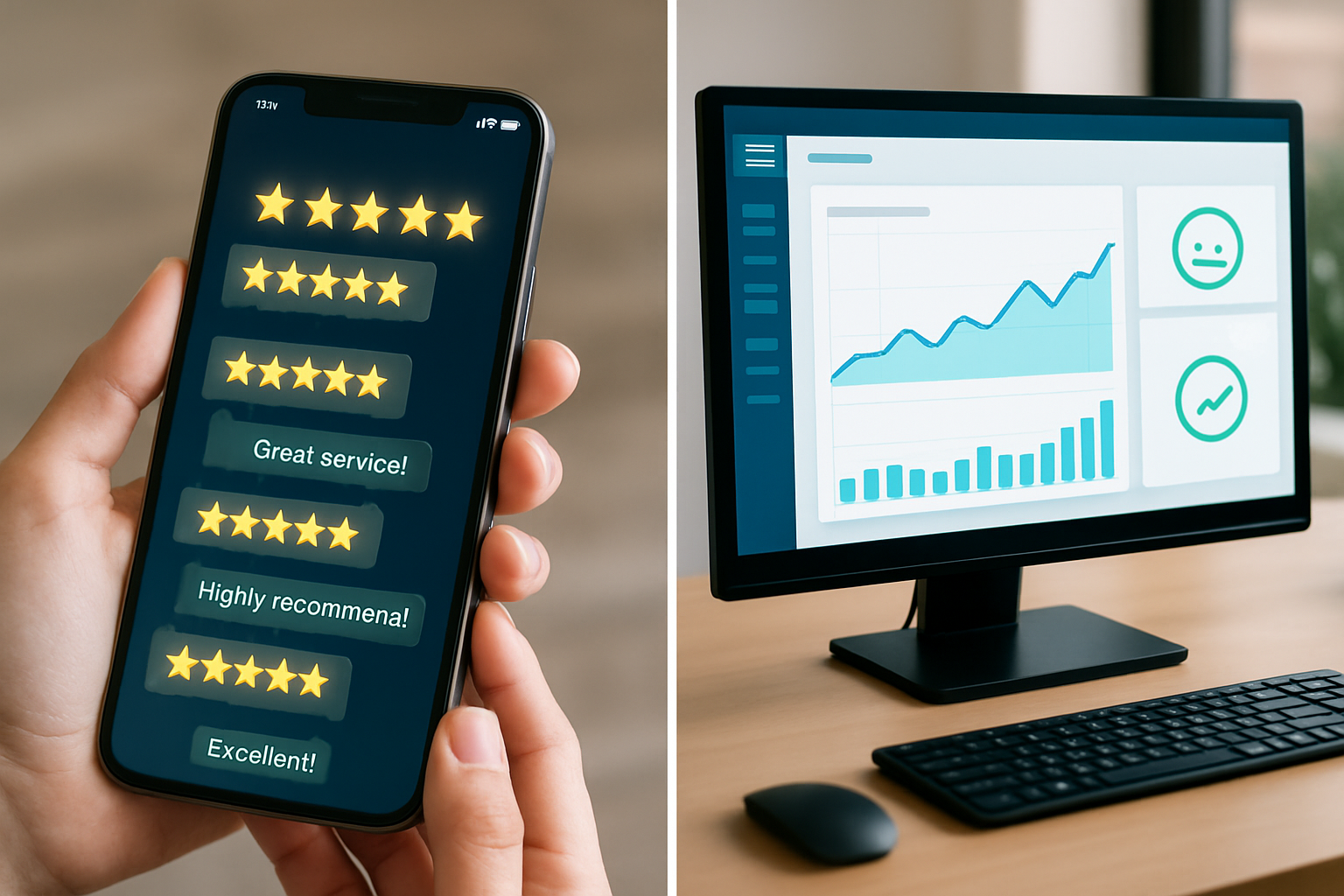
How to Monitor Your Online Reputation Effectively
You can't manage what you don't measure. Effective reputation monitoring means knowing what's being said about your business across every platform that matters—and catching it early enough to respond meaningfully.
Essential Platforms to Monitor
- Google Business Profile: The single most important platform for local businesses. Set up instant notifications for new reviews.
- Facebook: Reviews, comments on your posts, and mentions in local community groups.
- Industry-specific review sites: Yelp for restaurants, Healthgrades for medical practices, Avvo for lawyers.
- Better Business Bureau: Still matters for credibility, especially with older demographics.
- Social media mentions: Track brand mentions even when you're not tagged.
Tools That Actually Work
Manual monitoring works when you're just starting out, but it doesn't scale. Here's what we recommend based on budget:
Free tier: Google Alerts for your business name, Google Business Profile app for review notifications, native social media notifications. This covers the basics but requires daily manual checking.
Small business tier ($50-200/month): Platforms like Birdeye, Podium, or ReviewTrackers aggregate reviews across multiple sites, send automated alerts, and provide response tools. The time savings alone justify the cost for most businesses.
Enterprise tier ($200+/month): Reputation.com, Brandwatch, or similar tools that add sentiment analysis, competitive benchmarking, and advanced reporting. Only necessary if reputation is absolutely critical to your business model or you're managing multiple locations.
The right choice depends on your volume. If you're getting fewer than 10 reviews monthly across all platforms, start with free tools. Above that threshold, paid tools save enough time to pay for themselves.
Setting Up an Effective Monitoring Schedule
Daily: Check Google Business Profile and primary social channels. Respond to any new reviews or comments.
Weekly: Search your business name on Google and review aggregator sites. Check for unlinked mentions or discussions.
Monthly: Analyze trends in review sentiment, identify recurring themes in feedback, and adjust operations accordingly.
The Art of Responding to Reviews (Good and Bad)
Most small businesses get this backwards. They ignore positive reviews and panic over negative ones. The right approach is exactly opposite: leverage positive reviews strategically and handle negative reviews calmly.
Responding to Positive Reviews
Every positive review deserves a response. It's not just courtesy—it's a ranking signal. Google sees engagement as a sign of an active, customer-focused business.
Keep responses:
- Personal: Reference specific details from their review. "We're so glad you loved the ribeye, Tom" beats "Thanks for the review" every time.
- Brief: 2-3 sentences maximum. You're acknowledging them, not writing a novel.
- Brand-aligned: Match your business's tone. A law firm shouldn't sound like a surf shop.
- Action-oriented: Invite them back, suggest they try something new, or ask them to share their experience with friends.
Example: "Thanks for taking the time to leave this review, Jennifer! We're thrilled the team could get your furnace running before that cold snap hit. If you ever need anything else, you know where to find us."
Responding to Negative Reviews
This is where small businesses either shine or completely implode. The rules are straightforward:
Respond quickly. Within 24 hours if possible, 48 hours maximum. Speed shows you're paying attention and care about customer experience.
Never get defensive. Even when the review is unfair, inaccurate, or written by a competitor's cousin. The moment you get combative, you've lost every person reading that thread.
Acknowledge and offer to resolve. You don't have to admit fault, but you do have to show empathy. "I'm sorry you had that experience" costs nothing and de-escalates immediately.
Take it offline quickly. Provide a direct phone number or email in your response. Don't try to resolve complex issues in a public review thread.
Example template: "I'm sorry to hear your experience didn't meet expectations, [Name]. This isn't the standard we hold ourselves to. I'd like to understand what happened and make it right. Please call me directly at [phone] or email [email] so we can discuss this further."
Then—and this is critical—actually follow through. Call them. Make it right. Not just because it might change their review (it often does), but because it's the right thing to do and every other reader is watching how you handle it.
When to Not Respond
Some reviews don't deserve a response. Obvious spam, competitors posing as customers, or reviewers making clearly false claims that you can document as untrue. In these cases, flag the review through the platform's reporting system and move on. Don't feed trolls.
Proactive Reputation Building Strategies
The best defense is a good offense. Instead of waiting for reviews to trickle in randomly, successful businesses actively generate positive reviews and testimonials.
Systematic Review Generation
Create a process for asking satisfied customers to leave reviews. This isn't sleazy—it's smart business. The key is timing and making it easy.
Best practices:
- Ask immediately after a positive interaction or successful project completion
- Send a direct link to your preferred review platform (usually Google)
- Provide simple instructions—assume they've never left a review before
- Follow up once if they don't respond, then drop it
Email template: "Hi [Name], thanks for choosing [Business] for [service]. If you were happy with how everything turned out, would you mind taking 60 seconds to share your experience on Google? It really helps other folks in Billings find us. Here's the direct link: [link]. Thanks again!"
Text message works even better for many demographics. Keep it conversational and brief.
Making It Easy
Friction kills follow-through. Create a simple, memorable short link (like yourdomain.com/review) that redirects to your Google Business Profile review page. Print it on receipts, add it to email signatures, include it in project completion emails.
The easier you make it, the more reviews you'll get. That's why businesses using review management platforms that automate this process typically see 3-5x more reviews than those relying on manual asks.
Diversifying Your Review Profile
Don't put all your reputation eggs in one basket. While Google is critical for local search, having reviews across multiple platforms builds credibility and protects against algorithm changes.
Focus on platforms where your customers actually spend time. A B2B service company might prioritize LinkedIn recommendations and industry-specific directories. A restaurant should focus on Google, Facebook, and Yelp.
This connects directly to your broader social media presence—being active where your customers are makes review generation natural rather than forced.
Managing Your Reputation Across Social Media
Reviews are one piece of the puzzle. Your social media presence is the other. Every post, comment, and interaction shapes how people perceive your business.
Consistency Matters
A dormant social media account is worse than no account at all. It signals that you're not paying attention, don't care about customer engagement, or possibly even that you're out of business.
You don't need to post daily on every platform. But you do need consistent activity on the platforms that matter for your industry. For most small businesses, that means Facebook and Instagram at minimum, possibly LinkedIn for B2B companies.
Using social media management tools makes this sustainable without burning out. Batch-create content monthly, schedule it out, then stay responsive to comments and messages in real-time.
Responding to Social Media Comments
Every comment deserves acknowledgment. Positive comments get a like or brief reply. Questions get answered. Complaints get handled with the same care as negative reviews—acknowledge, empathize, offer to resolve offline.
The businesses that build the strongest reputations on social media treat it like a conversation, not a broadcast channel. They respond quickly, show personality, and make followers feel heard.
Handling Social Media Crises
When something goes viral in a bad way—a customer service disaster caught on video, a controversial statement misinterpreted, a product failure that spreads—speed and transparency are everything.
Acknowledge it immediately. Don't wait to craft the perfect response. "We're aware of [situation], looking into it, and will update you as soon as we have more information" buys you time and shows you're engaged.
Take responsibility if you're at fault. No weasel words, no blame-shifting. "We screwed up and here's how we're fixing it" earns more respect than any amount of spin.
Communicate the solution publicly once you have one. Show what you learned and what you're changing to prevent recurrence.
Crisis Management: When Things Go Wrong
Eventually, something will go wrong. A major customer complaint. A negative news story. An employee's social media mistake attributed to your business. How you handle it determines whether it's a temporary setback or a permanent scar.
The First 24 Hours
Monitor the situation closely. Set up alerts for your business name and related keywords. Understand the scope before responding.
Assemble your response team. For small businesses, this might just be you and your marketing contact (like the team at Agency 220). Know who's authorized to speak publicly and who isn't.
Prepare a holding statement if you need time to investigate. Never say "no comment"—it makes you look guilty or indifferent.
Responding Effectively
Facts first. What happened, when, and to whom. No speculation or assumptions.
Accountability second. If you're at fault, own it. If you're not, calmly correct the record with evidence.
Solution third. What are you doing to fix it and prevent it from happening again.
Long-term Reputation Repair
Once the immediate crisis passes, you need to rebuild. This takes time and consistent positive actions.
Double down on quality and customer service. Every positive interaction and review gradually buries the negative incident in search results and public memory.
Create new positive content. Blog posts, case studies, video testimonials—all of this pushes negative content further down in search results.
Stay engaged with your community. Sponsor local events, support local causes, be visible in positive ways. This builds a reservoir of goodwill that buffers against future issues.
Measuring Your Reputation Management Success
What gets measured gets managed. Track these metrics monthly to understand whether your reputation management efforts are working:
Core Metrics
- Average star rating: Across all platforms, weighted by platform importance to your business
- Review volume: Total new reviews per month, broken down by platform
- Response rate: Percentage of reviews you respond to within 48 hours
- Sentiment trend: Positive vs. negative review ratio over time
- Search visibility: Your ranking for "[your business type] + [your city]" searches
Business Impact Metrics
Reputation improvements should correlate with business outcomes. Track:
- Website traffic from local search and review platforms
- Conversion rate of visitors from review sources vs. other channels
- New customer acquisition cost and how it changes as your reputation improves
- Customer lifetime value for customers who mentioned reviews as a decision factor
If you're measuring content ROI and SEO performance already, reputation metrics fit naturally into that framework. Your review profile affects search rankings, which affects traffic, which affects revenue.
Setting Realistic Benchmarks
For small businesses just starting active reputation management:
Year one: Aim for a 0.5-star improvement in average rating, 3x increase in total reviews, 90%+ response rate to all reviews.
Year two: Maintain or improve star rating, steady review flow (target 1-2% of customers leaving reviews), dominant presence in local search results for your key terms.
Year three and beyond: Reputation becomes a competitive moat. You should be the clear review leader in your category and market.
Moving Forward: Your Reputation Action Plan
Your online reputation isn't something you fix once and forget. It's an ongoing process that becomes easier and more valuable the longer you stick with it.
Start here:
This week: Claim and optimize your Google Business Profile if you haven't already. Set up review monitoring. Respond to any outstanding reviews.
This month: Implement a systematic process for asking satisfied customers for reviews. Decide which platforms matter most for your business and create profiles if needed. Schedule time weekly for reputation monitoring and response.
This quarter: Analyze your review themes to identify operational improvements. Create content that showcases your expertise and customer success. Consider whether paid reputation management tools would save you time and improve consistency.
Remember Sarah, the restaurant owner from the beginning? After implementing a systematic reputation management strategy—monitoring daily, responding to everything, actively generating reviews from happy customers—she rebuilt her rating to 4.7 stars within six months. More importantly, she turned reputation management from a crisis into a competitive advantage. Her restaurant now consistently outranks larger competitors in local search, and she attributes 30% of new customer acquisition to her strong online presence.
Your reputation is already being shaped online whether you're actively managing it or not. The question is whether you're going to let others define your business or take control of the narrative yourself.
If you're ready to build a reputation management strategy that actually works for your business, our team specializes in helping small businesses in Billings and across Montana take control of their online presence. We handle the monitoring, response coordination, and strategic review generation so you can focus on running your business.
Frequently Asked Questions
How long does it take to improve a damaged online reputation?
For most small businesses, you'll see measurable improvement in 3-6 months with consistent effort. This includes actively generating new positive reviews (aim for 5-10 per month minimum), responding to all feedback promptly, and addressing the underlying issues that caused negative reviews. Severe reputation damage can take 12-18 months to fully overcome, but you should see positive momentum much sooner. The key is that newer reviews carry more weight in algorithms and customer perception than old ones, so consistent positive feedback gradually buries past problems.
Should I pay to remove negative reviews?
No. Services that promise to remove legitimate negative reviews are either scams or using tactics that violate platform terms of service. This can get your business banned from review platforms entirely. The only reviews you can legitimately remove are fake ones that violate the platform's policies (spam, posted by competitors, contain profanity or threats, etc.). Focus instead on generating enough new positive reviews that negative ones become statistically insignificant and buried in the feed. A mix of positive and negative reviews is actually more trustworthy than a perfect 5.0 rating anyway.
How many reviews does a small business actually need?
For local search credibility, aim for at least 40-50 Google reviews minimum, with a target of adding 5-10 new reviews monthly. This puts you in competitive range with most small businesses in your market. The volume matters less than consistency—businesses with recent, steady review flow rank better than those with many old reviews but nothing new. Review quantity also depends on your industry and market. A restaurant in a competitive market might need 200+ reviews to stand out, while a B2B service company with 50 detailed reviews could dominate their niche.
Can I offer incentives for customers to leave reviews?
Google's policy explicitly prohibits offering compensation, discounts, or incentives in exchange for reviews. Violating this can get your Google Business Profile suspended. You can incentivize feedback generally (like entering everyone who provides feedback into a drawing), but you cannot specifically incentive positive reviews or reviews on particular platforms. The safest approach is to simply make asking for reviews part of your standard customer follow-up process, provide a convenient link, and let satisfied customers decide to leave reviews on their own. This generates authentic reviews that help your credibility far more than incentivized ones anyway.
What should I do about fake negative reviews from competitors?
First, flag the review through the platform's reporting system with specific evidence of why it's fake (reviewer never used your service, posted same review on competitor's page positively, account was just created, etc.). Google and other platforms do remove fake reviews, but it can take weeks and isn't guaranteed. While waiting, respond professionally to the review noting that you have no record of this customer and inviting them to contact you directly to resolve the situation. This signals to other readers that something's off. Then focus on generating more legitimate positive reviews to dilute the impact. If fake reviews become a pattern, document everything and consider legal action for defamation or tortious interference, though this is expensive and should be a last resort.