Social Media Advertising Strategy: The Complete 2026 Guide for Small Businesses
Build a social media advertising strategy that connects ad spend to real revenue—with platform selection, targeting, budgeting, and optimization tactics that actually work.
Your competitors are spending money on social media ads right now. Some are seeing real returns—new customers, booked appointments, actual revenue. Others are bleeding cash with nothing to show for it. The difference? A social media advertising strategy that connects business goals to the right platforms, audiences, and content.
Without a clear strategy, you're just throwing money at algorithms and hoping something sticks. With one, every dollar works toward measurable growth. This guide walks you through building a complete social media advertising strategy from scratch—one that actually fits your business, your budget, and your goals.
Table of Contents
Why Social Media Advertising Strategy Actually Matters
Paid social media is no longer optional for most businesses. Organic reach has dropped to single digits on most platforms. If you want to reach new customers, you need to pay for visibility.
But here's the problem: most small businesses approach social ads like a light switch. They boost a post when business is slow, spend $50, see minimal results, and declare social advertising doesn't work.
A proper strategy changes everything. It determines which platforms deserve your budget, what messages resonate with your audience, and how to measure success beyond vanity metrics like likes and shares. When you align your ad spend with specific business outcomes—like qualified leads or direct sales—you stop wasting money on irrelevant clicks.
According to recent data, businesses that document their social media strategy are 313% more likely to report success than those who don't. That's not a coincidence. Strategy creates consistency, allows for testing, and gives you a framework for improvement.
The Real Cost of No Strategy
Without a strategy, you're vulnerable to every shiny object. A new platform launches, you jump in without considering if your customers are there. You see a competitor's ad and try to copy it without understanding their goals or budget. You chase engagement metrics that don't translate to revenue.
The cost isn't just wasted ad spend—it's the opportunity cost of what that money could have done with proper targeting and messaging. For small businesses operating on tight margins, that difference matters.
Set Clear Objectives That Connect to Revenue
Start with the end in mind. What specific business outcome are you trying to drive? "Getting our name out there" isn't a strategy—it's a hope.
Your objectives should connect directly to revenue or clear steps in your customer journey. Common objectives include:
- Generate qualified leads for your sales team
- Drive direct sales through e-commerce
- Increase appointment bookings
- Build an email list of potential customers
- Re-engage past customers for repeat business
Each objective requires different tactics, platforms, and measurement approaches. A local Billings restaurant trying to fill tables on slow Tuesday nights needs a completely different strategy than a Montana-based e-commerce brand trying to scale nationally.
Pick one or two primary objectives. Trying to accomplish everything at once dilutes your budget and makes it impossible to measure what's working. You can always expand once you've proven success with your initial goals.
Connect Objectives to Specific Metrics
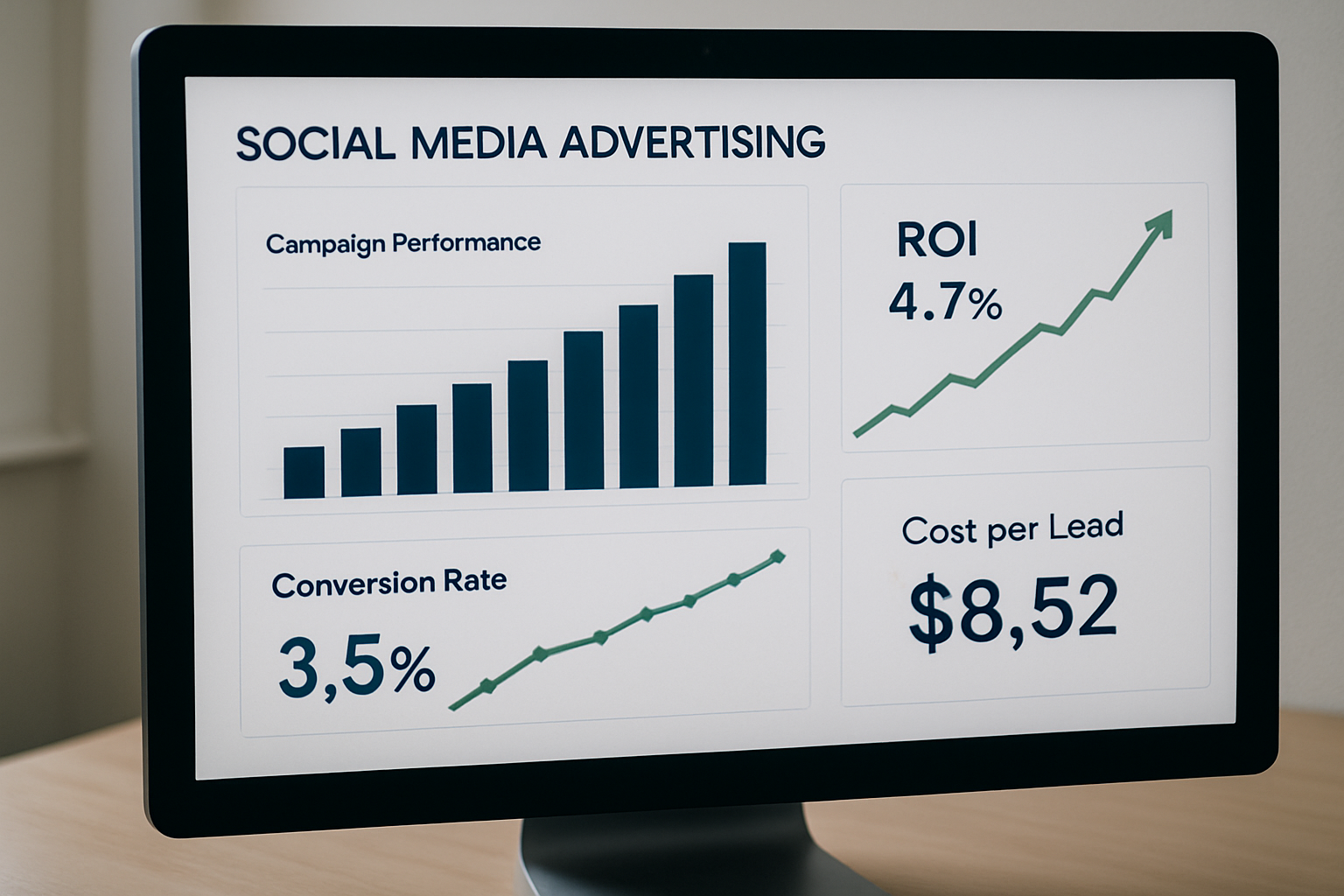
Once you've defined your objective, identify the metrics that prove you're making progress. If your goal is lead generation, track cost per lead, lead quality, and conversion rate to customer. If it's direct sales, track return on ad spend (ROAS) and customer acquisition cost.
This clarity makes optimization possible. When you know exactly what you're trying to improve, you can test systematically and make data-driven decisions about where to invest more budget. Our guide on measuring social media ROI breaks down the specific metrics worth tracking for different business models.
Choose the Right Platforms for Your Audience
Not all social platforms deliver equal results for every business. Your customers aren't everywhere—and you don't need to be either.
Each platform serves different demographics, use cases, and ad formats. Facebook and Instagram dominate for broad reach and sophisticated targeting. LinkedIn works for B2B and professional services. TikTok captures younger audiences with video content. Pinterest drives product discovery and purchase intent.
Rather than spreading your budget thin across every platform, concentrate on the one or two where your ideal customers actually spend time. A commercial roofing company targeting property managers gets better results on LinkedIn than TikTok. A boutique targeting women 25-45 might find its sweet spot on Instagram and Facebook.
Our breakdown of the best social media platforms for local businesses helps you match your business type to the platforms most likely to deliver results.
Platform Selection Criteria
Consider these factors when choosing platforms:
- Audience demographics: Where does your target customer spend time?
- Ad format strengths: Do you need video, images, or text-heavy ads?
- Cost efficiency: Some platforms are more expensive than others for the same reach
- Competition level: Highly saturated platforms might require bigger budgets
- Your content capabilities: Can you create the type of content that works on this platform?
Start with one platform, prove your strategy works, then expand. Sequential growth beats simultaneous mediocrity.
Define Your Target Audience Beyond Demographics
Age and location aren't enough. The 35-year-old woman in Billings who needs a plumber at 10 PM because her basement is flooding is different from the 35-year-old woman planning a bathroom remodel three months from now—even though they're the same demographic.
Effective targeting considers:
- Pain points and problems: What keeps them up at night?
- Intent signals: What behaviors indicate they're ready to buy?
- Customer journey stage: Are they problem-aware, solution-aware, or ready to choose a vendor?
- Psychographics: What do they value? What drives their decisions?
Modern ad platforms let you target based on behaviors, interests, and intent—not just demographics. Someone who recently engaged with home improvement content, visited contractor websites, and lives in your service area is a far better prospect than someone who simply fits your age range.
Advanced approaches like AI customer segmentation can help you identify patterns in your best customers and find more people like them.
Building Custom and Lookalike Audiences
Your existing customers are your best targeting template. Upload your customer list to create custom audiences for re-engagement campaigns. Then create lookalike audiences to find new prospects who share characteristics with your best customers.
This approach works because it's based on actual behavior, not assumptions about who your customer should be. A Billings HVAC company might discover their best customers aren't who they initially thought—and adjust targeting accordingly.
Budget Allocation and Bidding Strategies
How much should you spend? The honest answer: enough to test effectively and scale what works. But that's not particularly helpful when you're staring at a blank budget spreadsheet.
We've written extensively about social media advertising budgets for small businesses, but here's the short version: start with what you can afford to lose while learning, aim for at least $10-15 per day per platform to gather meaningful data, and plan to increase budget on campaigns that prove profitable.
Most platforms use auction-based bidding. You're competing against other advertisers for the same audience's attention. Your bid, combined with your ad quality and relevance, determines how often your ads show and to whom.
Bidding Strategy Options
Different bidding strategies optimize for different goals:
- Cost per click (CPC): You pay when someone clicks your ad—good for driving traffic
- Cost per thousand impressions (CPM): You pay per 1,000 views—good for awareness
- Cost per action (CPA): You pay when someone completes a specific action—good for conversions
- Cost per lead (CPL): You pay when someone submits their information—good for lead generation
Start with platform-recommended bidding strategies while you gather data. Once you understand your numbers—average conversion rate, value per customer, acceptable acquisition cost—you can make more aggressive bidding decisions.
Testing Budget Allocation
Allocate 70% of your budget to proven performers and 30% to testing new audiences, ad formats, or platforms. This balance lets you maintain consistent results while exploring opportunities for improvement.
Track your cost per result religiously. If Facebook delivers leads at $25 each and Instagram delivers them at $60, shift budget accordingly—unless those Instagram leads convert at a higher rate, in which case the higher upfront cost might be worth it.
Create Ad Content That Stops the Scroll
Your audience sees hundreds of ads every day. Most get scrolled past in under a second. Your content needs to earn attention immediately.
Effective social ad content follows a simple pattern: hook them in the first second, communicate clear value, and give them one specific next step. No corporate jargon, no vague promises, no clever wordplay that obscures what you're actually offering.
Visual Content That Converts
Static images still work, but video outperforms on almost every platform. You don't need a Hollywood production—authenticity often beats polish. A Montana contractor showing a real job site with honest commentary can outperform a slick stock footage compilation.
Key visual principles:
- Bright, high-contrast images that pop in the feed
- Text overlays that communicate value without sound
- People and faces increase engagement (humans connect with humans)
- Show the transformation or result, not just the process
- Mobile-first formatting (most views happen on phones)
If you're managing multiple campaigns across platforms, social media management tools can streamline your content creation and scheduling process.
Writing Copy That Converts
Your ad copy should pass the "so what?" test. Every sentence should answer the reader's internal question: "Why should I care?"
Lead with the benefit, not the feature. "Get your furnace running before the Montana winter hits" beats "24-hour HVAC service available." Both communicate the same service, but one connects to a real fear and need.
Use specific numbers and deadlines when possible. "Save $500 on installation this week" outperforms "Save money on installation" because it's concrete and time-bound.
End with a clear, singular call-to-action. Don't ask them to "learn more, call us, or visit our website." Pick one action that maps to your campaign objective. If you're generating leads, send them to a dedicated landing page that continues the message from your ad.
Track Performance and Optimize Relentlessly
Launching campaigns is the easy part. Making them profitable requires continuous testing and refinement.
Install proper tracking before you spend a dollar. At minimum, you need platform pixels (Facebook Pixel, LinkedIn Insight Tag, etc.) and conversion tracking to see which ads drive actual business results—not just clicks.
Google Analytics or similar tools should track the full journey from ad click to conversion. If someone clicks your Facebook ad, browses your site, and calls you two days later, you need to connect that revenue back to the ad that started the journey.
What to Test and How Often
Run controlled tests on one variable at a time:
- Audiences: Test different targeting parameters against each other
- Ad creative: Test different images, videos, or copy approaches
- Offers: Test different value propositions or incentives
- Landing pages: Test different post-click experiences
- Ad placements: Test different positions and formats
Give tests enough time and budget to reach statistical significance. Running a test for two days with a $20 budget tells you nothing. Plan for at least a week and several hundred impressions per variation.
Document what you learn. A spreadsheet tracking test results, winner, and key insights becomes incredibly valuable over time. Six months from now, you won't remember why you stopped targeting that audience or changed that headline—unless you write it down.
The same discipline that improves content ROI and SEO performance applies to paid social: measure, test, learn, repeat.
When to Scale and When to Kill
If a campaign is profitable at small scale, gradually increase budget while monitoring efficiency. A campaign delivering $3 in revenue for every $1 spent won't necessarily maintain that ratio at 5x the budget—but you won't know until you test.
Kill campaigns that consistently underperform after you've tested variations. Sunk cost fallacy kills ad budgets. Just because you spent money on creative or invested time in setup doesn't mean you should keep funding a losing campaign.
Common Social Media Advertising Mistakes to Avoid
Even with a solid strategy, certain mistakes can sabotage your results. Here are the most common traps:
Optimizing for the Wrong Metrics
Impressions and reach feel good but don't pay bills. A campaign with 100,000 impressions and zero leads is objectively worse than one with 5,000 impressions and 50 qualified leads—even though the vanity metrics look worse.
Focus on metrics that connect to revenue: cost per lead, conversion rate, customer acquisition cost, return on ad spend. Everything else is secondary.
Sending Traffic to Your Homepage
Your homepage serves many purposes—which makes it terrible at converting cold traffic from ads. When someone clicks an ad for "Montana HVAC emergency repair," they should land on a page exclusively about emergency repair, not your general homepage with links to every service you offer.
Create dedicated landing pages that match your ad message and remove distractions from the conversion goal. This approach is covered in detail in our guide to using landing pages to capture leads effectively.
Set It and Forget It
Ad performance degrades over time. Audiences get fatigued seeing the same creative. Competition changes. Platform algorithms evolve. What worked last quarter might stop working this quarter.
Schedule regular check-ins—weekly at minimum for active campaigns. Review performance, pause underperformers, increase budget on winners, and launch new tests. Tools for AI social media scheduling can help automate some of this work, but strategic decisions still require human judgment.
Ignoring Mobile Experience
Over 80% of social media usage happens on mobile devices. If your landing pages aren't mobile-optimized, you're throwing away most of your ad clicks.
Test every step of your funnel on a phone. If forms are hard to fill out, pages load slowly, or buttons are hard to tap, you're losing conversions. Our guide to mobile responsive design covers the technical requirements, but the principle is simple: design for the device people actually use.
Forgetting About Retargeting
Most people don't convert on their first visit. They browse, get distracted, compare options, or simply aren't ready to commit yet. That doesn't mean they're not interested.
Retargeting campaigns show ads to people who've already engaged with your business—visited your site, watched your videos, engaged with your content. These warm audiences convert at much higher rates than cold traffic because they already know who you are.
Set up basic retargeting campaigns for anyone who visits key pages but doesn't convert. These campaigns typically deliver some of the best ROI in your entire advertising budget.
Moving Forward With Your Strategy
Building an effective social media advertising strategy isn't about having the biggest budget or the fanciest creative. It's about aligning your spending with clear business objectives, targeting the right people with relevant messages, and continuously improving based on real performance data.
Start with one platform and one objective. Prove you can generate profitable results at small scale. Then expand budget, test new approaches, and gradually add complexity as you learn what works for your specific business.
The businesses seeing real returns from social advertising aren't necessarily doing anything complicated—they're just being systematic, measuring what matters, and refusing to waste money on tactics that don't drive results.
If you're ready to build a social media advertising strategy that actually connects to your revenue goals, Agency 220 works with businesses throughout Montana to develop and execute campaigns that deliver measurable growth. We handle everything from strategy development to campaign management and optimization—so you can focus on running your business while we focus on growing it.
Your competitors are already investing in social advertising. The question isn't whether you can afford to—it's whether you can afford not to.
Frequently Asked Questions